Below we go through, point by point, what to put in a garage rental agreement so that it protects both the owner and the tenant. At the end you will find an agreement template with a handover report to download.
Does a garage rental agreement have to be in writing?
You do not need a notary to rent a garage. You sign the agreement yourselves. The law does not require written form, but a rental for longer than a year concluded without a written agreement is deemed to be concluded for an indefinite period (Article 660 of the Polish Civil Code). A written agreement and a handover report are the simplest proof of what you agreed.
The Tenants' Rights Protection Act applies to residential premises, and a garage is not used for living in. A garage rental is governed by the Civil Code provisions on lease and by what the parties write into the agreement. That is why it is so important for the clauses to be specific.
What a garage rental agreement must contain - a checklist
- the parties to the agreement and the basis on which the landlord has the garage at their disposal,
- a description of the garage and its equipment,
- the purpose: a car, belongings, minor repairs,
- rent, payment date and additional charges, including electricity,
- the deposit and the rules for returning it,
- keys and remotes,
- what must not be kept in the garage,
- repairs and changes to the garage,
- the owner's access to the garage,
- insurance,
- duration of the agreement and termination,
- return of the garage and the report.
The parties and the right to the garage
Write down the names (or company names), addresses and contact details of the parties. It is enough to copy the details from an ID card into the agreement. There is no need to make a copy of the document.
The tenant should know on what basis the landlord has the garage at their disposal: whether they own it, rent it themselves or lease the land under it. Agreements with a municipality or a cooperative often prohibit subletting. In such a case, ask for the owner's consent in writing. If someone else rents out the garage on the owner's behalf, a power of attorney is needed.
Description of the garage and its purpose
Describe the address and number of the garage, its type (brick, metal, box in a hall), the dimensions of the interior and the door, and the equipment: electricity, lighting, inspection pit, shelving. Record the technical condition in the handover report with photos.
Specify what the garage is for: parking a car or motorcycle, storing belongings, minor repairs to your own car. The tenant is to use the garage as specified in the agreement (Article 666 § 1 of the Civil Code). If you do not agree to a workshop for customers or a company store, say so explicitly. Permanent service activity in a garage may also require a change in the use of the building.
Rent, electricity and charges
- The rent amount, the payment date (e.g. by the 10th day of the month) and the account number.
- Electricity: by sub-meter and readings or as a flat rate included in the rent. This is the most common source of disputes, so write down how it is settled.
- Who pays the charges to the cooperative, residents' association or manager of the garage complex. Usually the owner does, and the tenant pays the rent.
- Rent indexation: if you want to raise the rent, write down the rule, e.g. once a year by the inflation rate published by Statistics Poland (GUS).
Property tax is paid by the owner. Its amount depends on the type of garage, which we explain in the guide garage tax.
Deposit
The deposit rules of the Tenants' Rights Protection Act do not cover garages, so you set the terms yourselves. Write down:
- the amount of the deposit,
- what it secures: unpaid rent, electricity, damage, lost remotes,
- the deadline for returning it after the garage is handed back, e.g. 14 days,
- the rule that deductions must follow from the handover report or from bills.
Keys and remotes
Write down how many keys and remotes the tenant receives, whether they may have copies made and how much replacing the lock or a remote costs. The tenant is liable for a lost key or remote, unless they lost it through no fault of their own. In garages in halls, a lost remote may mean the manager has to reprogram the entrance gate, so it is worth settling this in advance.
What must not be kept in the garage
Fire regulations limit the amount of fuel in garages, and decanting fuel or refuelling in a garage is prohibited. The exact limits for garages of up to 100 m² and for larger halls are on the garages for rent page. In the agreement, it is enough to state that the tenant complies with fire regulations and with the rules of the garage complex or hall, which may, for example, prohibit entry by cars with LPG systems.
Repairs and changes to the garage
The landlord hands over the garage in a condition fit for use and keeps it in that condition. Minor outlays connected with ordinary use are borne by the tenant (Article 662 of the Civil Code). Write down examples: replacing a light bulb is the tenant's job, repairing the roof is the owner's.
Without the landlord's consent, the tenant may not make changes contrary to the agreement or to the garage's purpose (Article 667 § 1). Agree in writing on fitting shelves, an extra bolt or an alarm.
Improvements: if you agree nothing, after the rental ends the owner may keep them against payment or demand that the previous condition be restored (Article 676).
Owner's access and insurance
Write down that the owner enters the garage only after agreeing a time with the tenant, except in a sudden emergency, e.g. flooding. Also agree on insurance: the owner insures the garage, and the tenant insures their car and belongings. The owner is not liable for the tenant's belongings unless the damage results from the owner's fault, e.g. a neglected roof repair.
For how long, and how to terminate a garage rental agreement
- Open-ended agreement: unless the agreement says otherwise, with rent paid monthly it is terminated with one month's notice at the end of a calendar month, and a daily rental with one day's notice (Article 673 § 2).
- Fixed-term agreement: it can only be terminated in the cases written into the agreement (Article 673 § 3). So write in, for example, that either party may terminate it with one month's notice.
- Arrears: if the tenant is in arrears with rent for at least two full payment periods, the landlord may terminate the rental without notice (Article 672).
Returning the garage and the report
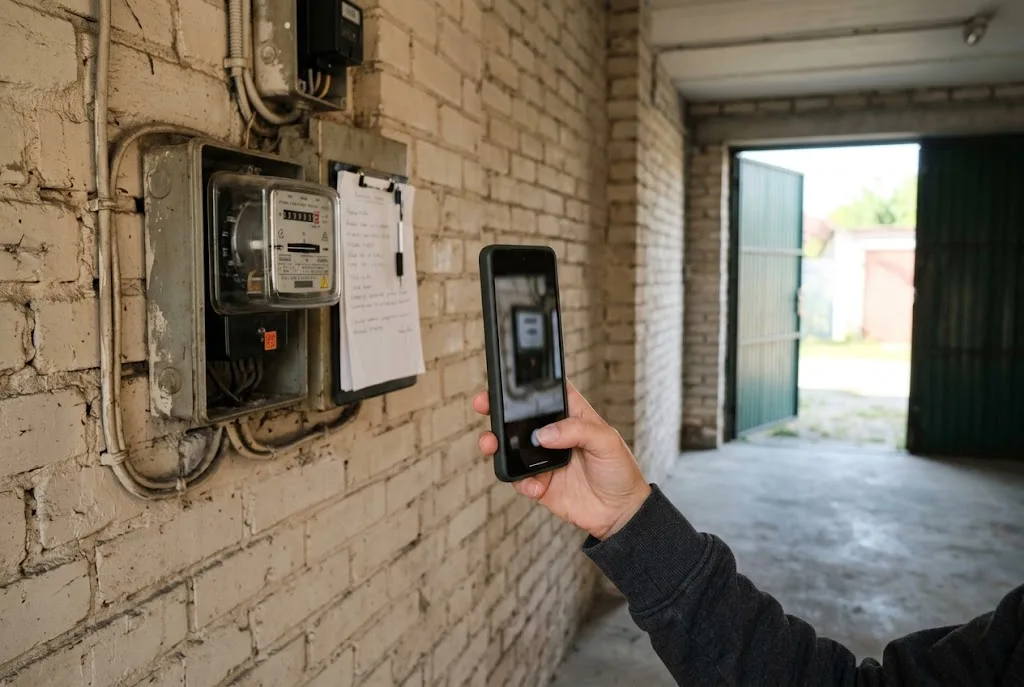
After the rental ends, the tenant returns the garage in an undeteriorated condition, but is not liable for wear resulting from proper use (Article 675 § 1). On return, draw up a report: the condition of the garage, photos, the number of keys and remotes handed back, the meter reading. Also agree what happens to belongings the tenant does not take. The owner may not throw them away or sell them on their own initiative, so write down the deadline for collecting them and how the tenant will be notified.
Renting a garage by the day or for a few weeks
For a short rental the agreement can be simpler, but still write down the dates, the price per day and the total amount, how the remote is handed over and returned, a deposit for the remote and a ban on leaving belongings after the end date. With a daily rental, either party may terminate it with one day's notice, unless they have agreed otherwise. If you rent out a garage as a business to private individuals online, consumer rights law also applies.
Garage rental agreement template to download
We have prepared a garage rental agreement template with a handover report that covers all the points described above. Fields to fill in are marked with dots, options to choose in square brackets, and clauses worth adapting to your situation come with tips.
Download the garage rental agreement template (DOCX, in Polish)
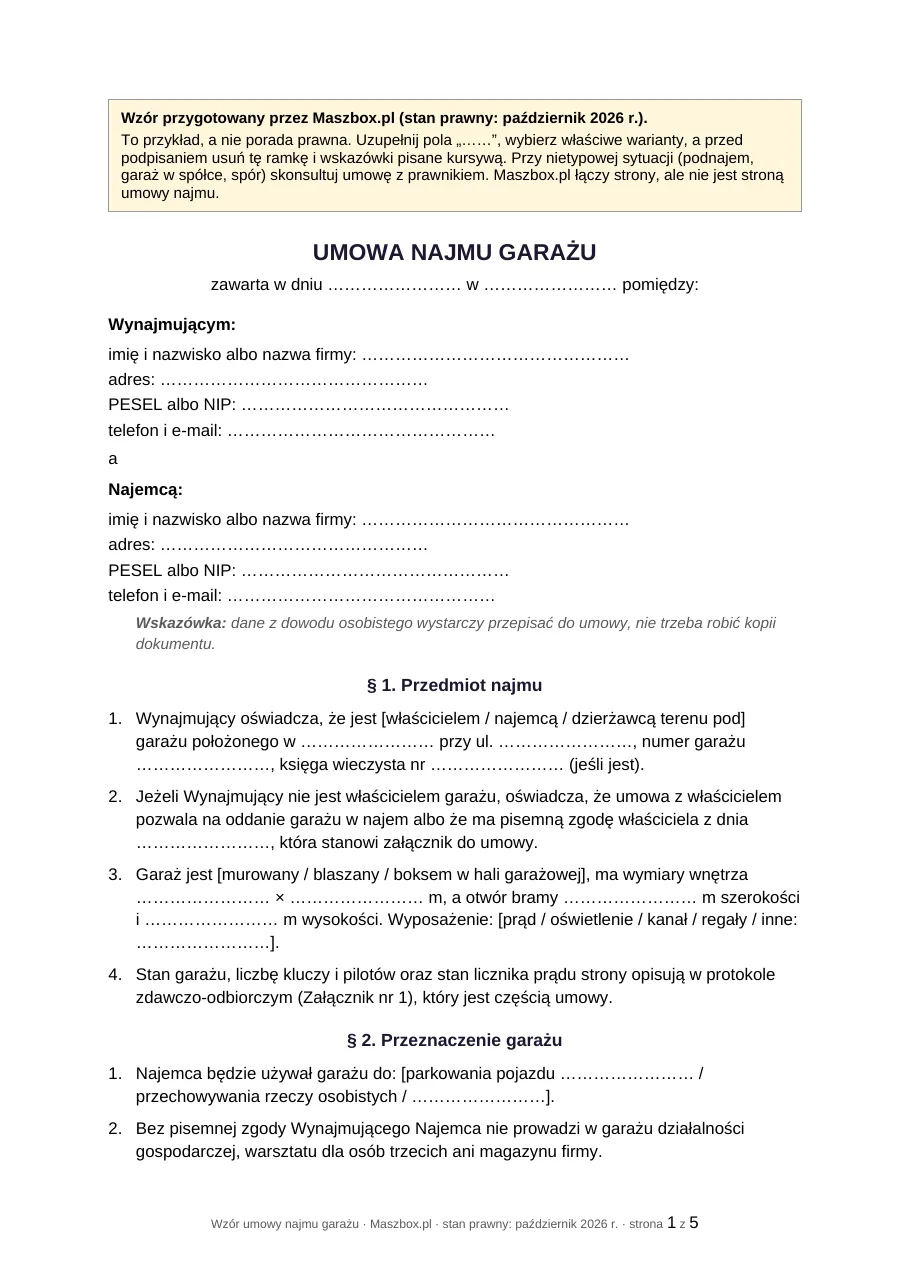
The template is a starting point, not legal advice. In an unusual situation, e.g. subletting or a garage owned by a company, have the agreement checked by a lawyer. Maszbox.pl connects the parties but is not a party to the rental agreement.
Tax on renting out a garage
You settle income from private rental with the flat-rate tax: 8.5% up to PLN 100,000 a year and 12.5% on the excess, without deducting costs. How to do it is described in the guide how to earn from spare space.

Marsel Zychowski
MaszBox Team
We share practical know-how on renting and selling space - garages, warehouses, storage units, parking spots and more.