Below we explain which rate applies to your garage in 2026, when a metal garage counts as a building, when to file IN-1 and who pays the tax when the garage is rented out or sold. Legal status as of 15 October 2026.
Garage tax in 2026 - the quick answer
| Type of garage | Tax rate | Maximum in 2026 (per 1 m² of usable floor area per year) |
|---|---|---|
| Garage in a residential building: built into a house, a garage unit in a block of flats, a share in a garage hall under a block | as for residential buildings | PLN 1.25 |
| Detached garage, garage in a row of garages, a metal garage that is a building | for other buildings | PLN 12.00 |
| Garage used for running a business | for buildings used for business | PLN 35.53 |
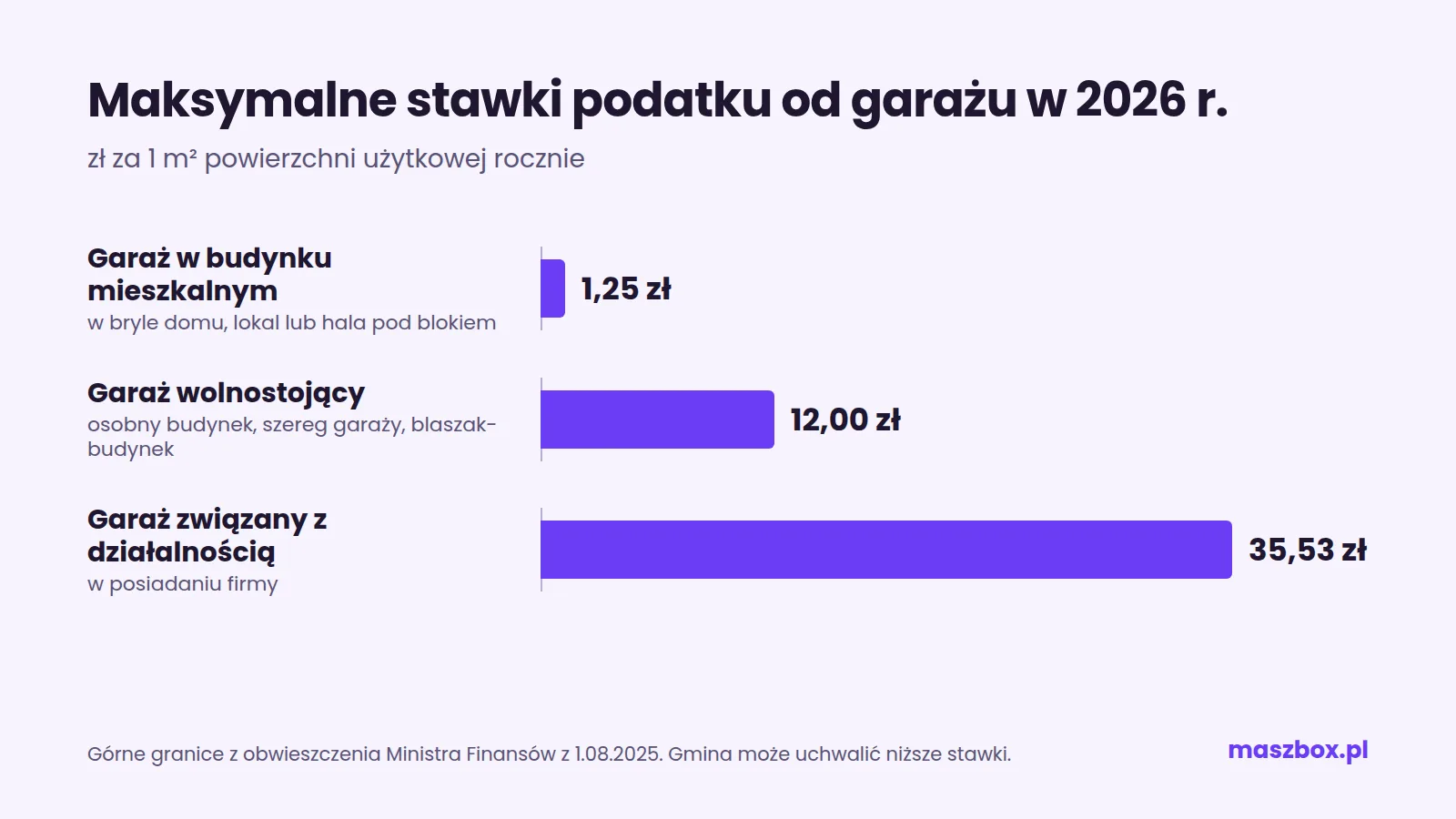
These are the upper limits of the rates, announced every year by the Minister of Finance. Your municipality adopts its own rates, and they may be lower. The municipal council may also differentiate the rates, e.g. set a separate, lower rate for detached garages. You will find the current rates in the municipal council's resolution on property tax rates for 2026, published in the municipality's Public Information Bulletin (BIP).
Example: a garage with a usable floor area of 18 m². At the maximum rates, the tax will be PLN 22.50 a year if the garage is part of a residential building, and PLN 216 a year if it stands separately. With a garage on your own plot, land tax is added on top.
A garage in a block of flats or a house: since 2025 the same rate as a flat
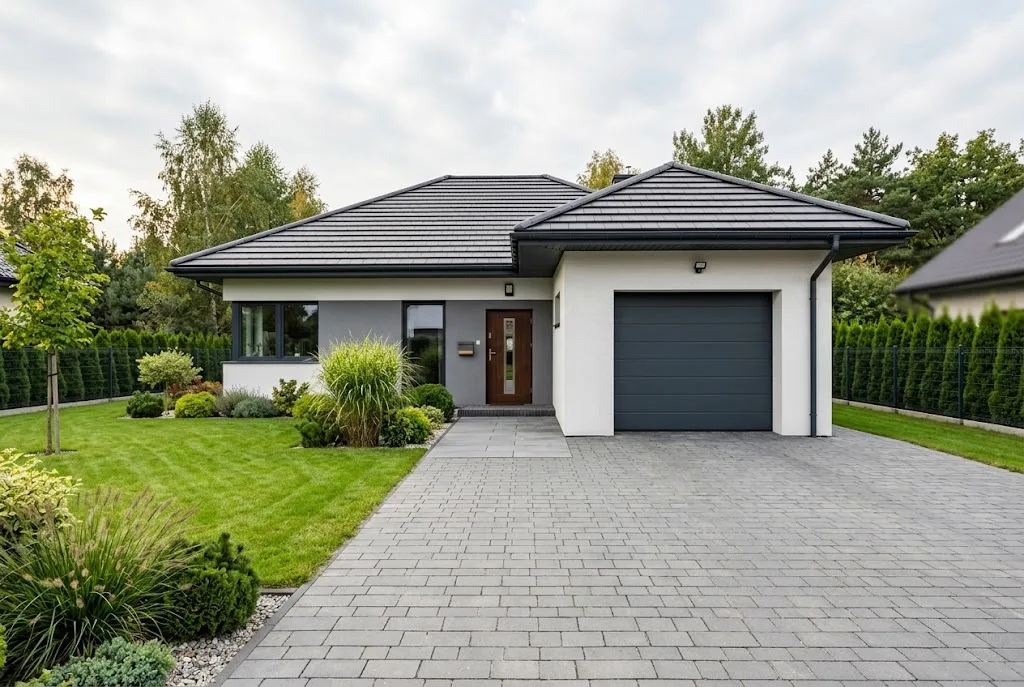
Since 1 January 2025, the Local Taxes and Fees Act has stated explicitly that a room intended for storing vehicles in a residential building is part of the residential part of that building (Article 1a(2c)). That is why you pay the lower rate for:
- a garage built into a single-family house,
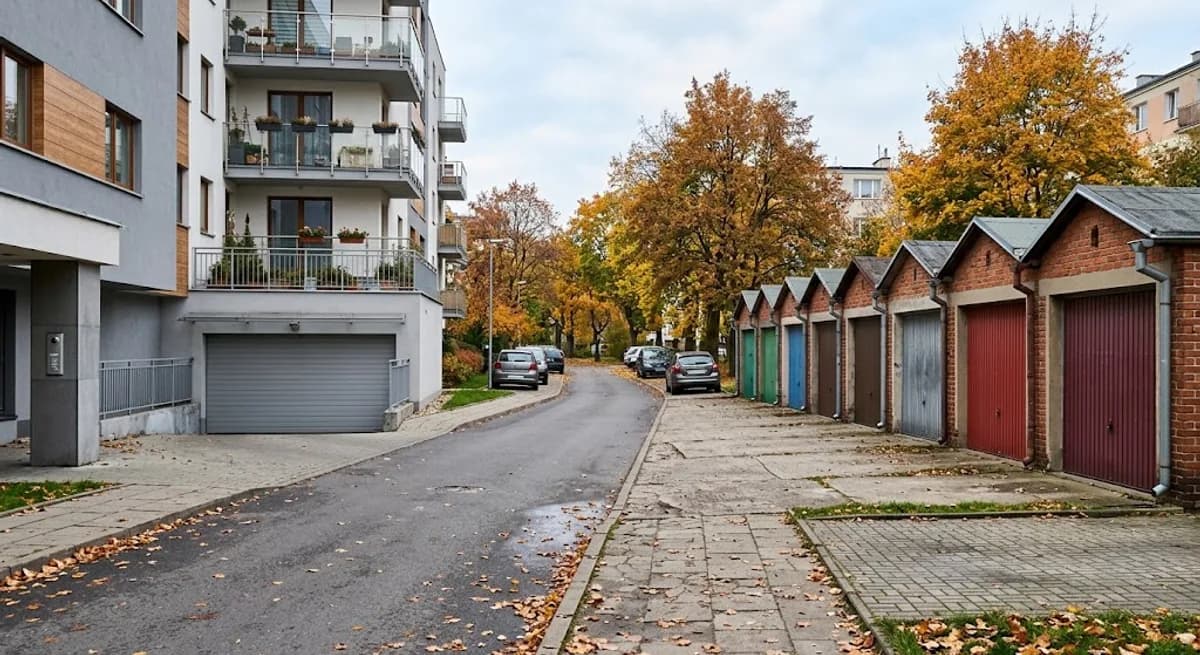
- a separate garage unit with its own land and mortgage register in a block of flats,
- a share in a garage hall under a residential building, including one with the right to a specific space.
Previously, separate garages in blocks of flats were often taxed at the rate for other buildings. This change covered only garages in residential buildings. If a garage in a block of flats serves your business, you pay the business rate.
Do you have a share in a multi-space garage unit in a residential building? You pay tax on your part, in proportion to your share. The co-owners of such a hall are not jointly and severally liable for the tax on the whole unit.
A detached garage and a garage in a row of garages: the higher rate
A garage that is a separate building is not part of a residential building. This applies to a garage on your plot next to the house, a garage in a row on an estate and a garage on cooperative land. For such a garage you pay the rate for other buildings, in 2026 at most PLN 12.00 per m².
This difference is disputed. In October 2025, the Commissioner for Human Rights supported before the Constitutional Tribunal the claim that differentiating the rate solely by whether the garage stands in a residential building violates the constitutional principle of equality. Until the law changes, municipalities apply the higher rate to detached garages.
Land under the garage. With a garage on your own plot, you also pay land tax. If the garage stands on land leased from the municipality or the State Treasury, you as the leaseholder may be the taxpayer for that land (Article 3(1)(4) of the Act). More on this in the section on renting.
A metal garage: when it is a building and tax must be paid
You pay property tax on buildings. Since 2025, the Act has had its own definition of a building: a structure erected as a result of construction works, permanently attached to the ground, separated from the surrounding space by building partitions, and having foundations and a roof. All these features must be present together.
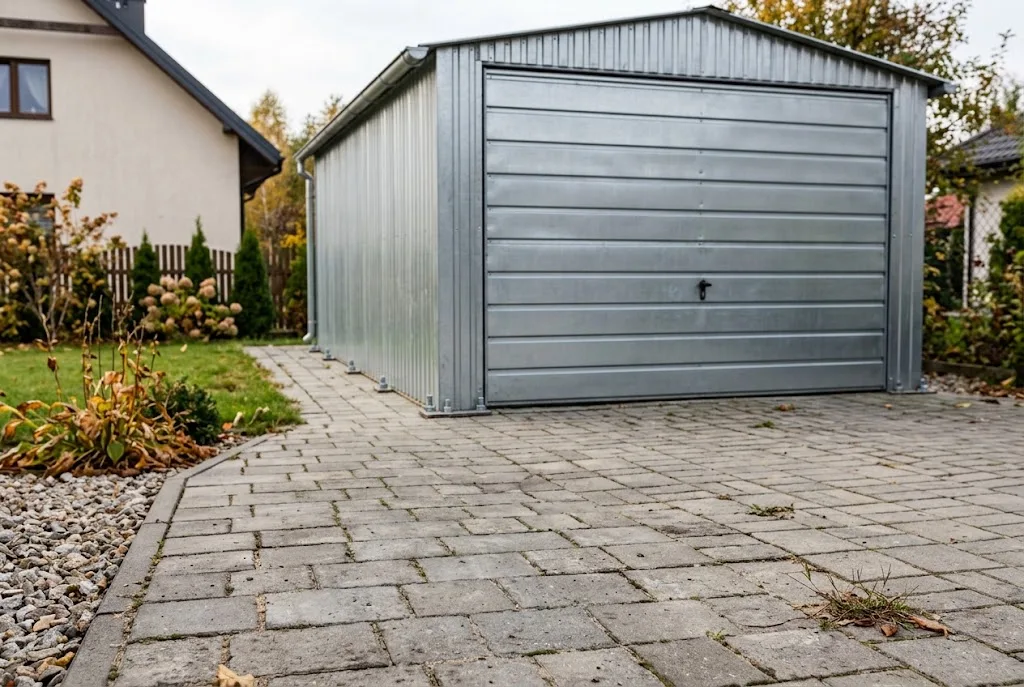
With a metal garage, the dispute usually concerns the foundation and permanent attachment to the ground. In November 2025, the Voivodeship Administrative Court in Łódź (case no. I SA/Łd 474/25) held that a metal garage standing on paving blocks and fixed to the ground was a building. According to the court, the ground served as a foundation, and the garage could not be moved without unscrewing the fixings.
- A metal garage anchored to a slab, a concrete base or paving blocks, especially one notified as a garage to the district office, will most likely be treated by the municipality as a building. You then pay the rate for other buildings.
- A metal garage placed loosely, without a foundation or fixings, may not meet the definition of a building. However, it is the municipality that assesses this in the specific case.
If you are not sure, you can apply to the head of the municipality, the mayor or the city president for an individual interpretation. Remember that whether a metal garage has to be notified to the district office is a separate matter, arising from the Building Law. We describe it in the guide on a metal garage without a permit.
Who pays the tax when a garage is rented
You rent a garage from a private person or a company: the owner pays the tax. The agreement may pass its cost on to you, e.g. in the rent, but towards the municipality the owner remains the taxpayer.
You rent a garage or lease land for a garage from the municipality or the State Treasury: you are the taxpayer as the possessor (Article 3(1)(4) of the Act). You must file the IN-1 information yourself. This applies to many garage complexes on city land.
You rent out your own garage to others: you still pay the property tax. On the rent you additionally pay the flat-rate tax on private rental (ryczałt): 8.5% of revenue up to PLN 100,000 a year and 12.5% on the excess. Details are in the guide how to earn from spare space.
If you do not run a business, renting out a garage does not by itself make it a “business” garage. If you run a business, ask your accountant whether the garage might be considered connected with the business. Then the highest rate applies.
When to report a garage to the municipality
A natural person files the property information (form IN-1) with the municipal office within 14 days of the event that creates or ends the tax liability. Such an event is, for example, a purchase, inheriting a garage, completion of construction or a sale.
The tax liability arises from the first day of the month following the month of purchase and expires at the end of the month in which you ceased to be the owner.
The municipality issues a decision, and you pay the tax in four instalments: by 15 March, 15 May, 15 September and 15 November.
A change in how the garage is used, e.g. starting a business in it, may also change the rate. Report it to the municipality by correcting the information.
Buying and selling a garage during the year
Did you buy a garage on 20 March? You pay the tax from 1 April, and the seller until the end of March. Both parties file information with the municipality within 14 days: the buyer on the acquisition, the seller on the disposal. How to prepare for a sale and when you will pay income tax is described in the guide on selling a garage step by step. Planning to buy a garage to rent out? See how to calculate whether buying a garage to rent out pays off.
This post is for information only. Confirm the amount of tax on your garage with the municipal office and, if you run a business, with your accountant.

Marsel Zychowski
MaszBox Team
We share practical know-how on renting and selling space - garages, warehouses, storage units, parking spots and more.