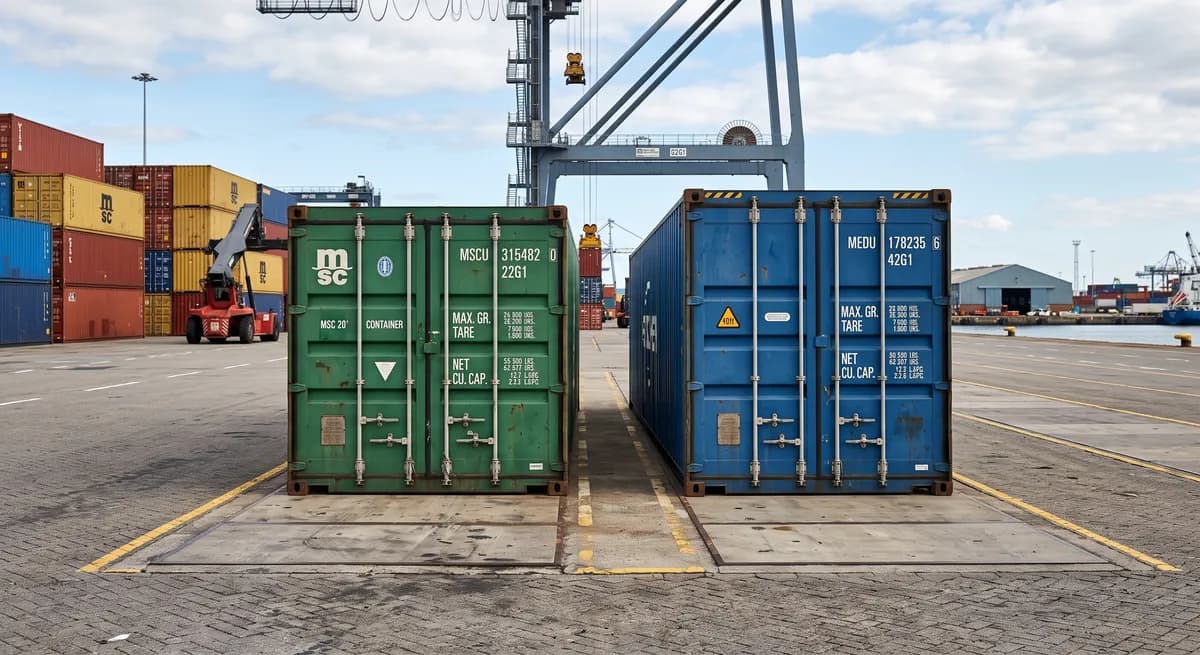
The wrong size costs money. A container that is too small means a second container or another transport. One that is too big means paying for empty space and the risk that a 12-metre box will not fit where you planned it. And if you do not check the door dimensions, you may find that a wardrobe will not go through the opening, even though there would be room for it inside.
Below we have gathered the dimensions of the most popular containers and show how to work out what size you really need.
Container dimensions at a glance
The size in feet is the container's external length. For storage, however, the internal dimensions and the door opening matter more:
| Type | Interior (L × W × H) | Floor area | Door opening (W × H) | Volume |
|---|---|---|---|---|
| 20' | approx. 5.90 × 2.35 × 2.39 m | approx. 13.9 m² | approx. 2.34 × 2.28 m | approx. 33 m³ |
| 40' | approx. 12.03 × 2.35 × 2.39 m | approx. 28.3 m² | approx. 2.34 × 2.28 m | approx. 67 m³ |
| 40' High Cube | approx. 12.03 × 2.35 × 2.70 m | approx. 28.3 m² | approx. 2.34 × 2.58 m | approx. 76 m³ |
Dimensions can differ by a few centimetres depending on the manufacturer. Listings also include 10-foot containers. They are less common and their dimensions vary, so with such an offer always check the exact dimensions in the listing or ask the advertiser.
How to work out how much space you need
- List the things you want to store and measure the largest of them: furniture, equipment, pallets.
- Work out how much floor they will take up. Things that can be stacked on top of each other or put on shelving take up less floor than it seems. The interior height of a standard container is about 2.39 m, so there is plenty of vertical space.
- Add a walkway. You need to reach things at the back without carrying everything outside, so leave enough room to walk through with a box in your hands.
- Leave some room for things you will add during storage.
If the total comes to a few square metres, even a 20-foot container may be too big. A smaller box in a self-service facility, that is self storage, or a warehouse in a building is then often the better choice. We describe the differences between a container and a warehouse in the article warehouse or container.
Door opening: check it before you move furniture in
The door opening is smaller than the container's interior. In standard 20' and 40' containers it is about 2.34 m wide and about 2.28 m high, and in the High Cube version about 2.58 m high. Before you bring a tall wardrobe, a ladder or a machine, measure it and compare it with the opening, not with the interior.
A standard container has doors in only one, shorter wall. In a 40-foot container this means about 12 metres deep from the entrance, so put rarely used things at the far end and frequently needed ones by the door. Listings also include containers with doors at both ends, which makes access easier in a long container.
When to choose the High Cube version
A High Cube is about 30 cm taller than a standard container. Choose it when:
- you store tall things or plan shelving right up to the ceiling,
- you want to insulate the container, because ceiling insulation takes up some of the height,
- you need a taller door opening to bring in large items.
If you mainly keep boxes, tools or garden furniture, the standard height is usually enough. How to plan shelving and the interior of a container that is yours is covered in the article owning a container.
Will a large container fit on the plot
A 40-foot container is about 12 metres long on the outside. Before you decide on this size, measure the place where it is to stand. Remember that you also need:
- room for the truck that delivers and unloads it, usually a truck with a crane,
- room in front of the doors, so they can be opened fully and things carried in.
On a small plot a 20-foot container is usually easier to place. What ground and access a container delivery requires is described with containers for rent.

Once you know what size you need, browse the listings in the containers category, or go straight to containers for sale if you plan to buy.

Marsel Zychowski
MaszBox Team
We share practical know-how on renting and selling space - garages, warehouses, storage units, parking spots and more.