
You own a storage unit you no longer need and you want to sell it, but the deed to your flat does not list it as a separate item, only as an appurtenant space.
Without formally separating it you cannot sign a contract of sale for the unit alone, because the notary has nothing to enter in the land register as an independent object of trade. The result: the transaction drags on, the buyer loses patience, and you have no idea where to start.
Below you will find the whole procedure, the real costs and what to watch out for, so you can sell the unit lawfully and without surprises. The article describes Polish rules, because that is where the listings on Maszbox.pl are located.
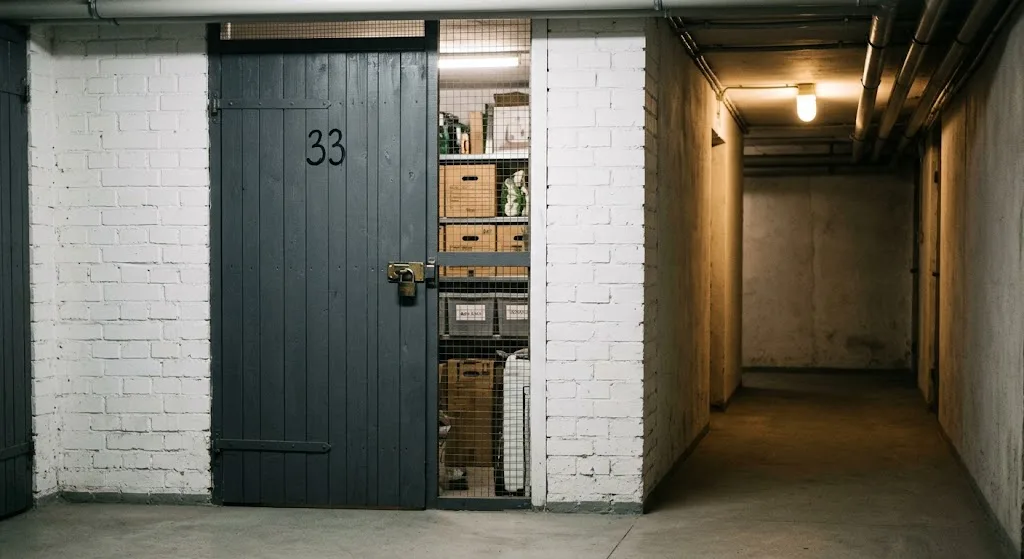
Can a storage unit be sold separately from the flat at all?
It depends on its legal status. By default a storage unit is a space appurtenant to the flat: under the Polish Ownership of Premises Act it is a component part of the flat and goes into the notarial deed together with it, not separately. An independent sale becomes possible only once the unit has been formally separated as a distinct premises with its own land register entry.
The Supreme Court resolution that changed this (III CZP 52/18)
On 15 November 2018 the Polish Supreme Court issued a resolution (ref. III CZP 52/18) on the sale of a storage unit between owners within the same homeowners association. It concerned a case in which the buyer wanted to merge the purchased unit into premises they already owned.
The court confirmed that such a transaction is permissible, but that it requires the consent of the remaining owners expressed in a resolution, under art. 22 sec. 4 of the Ownership of Premises Act, the provision on dividing and merging premises. Without that consent the act is invalid. The resolution is now cited as a precedent when storage units are formally separated, also beyond the original facts of the case.
How to formally separate a storage unit - step by step
Step 1 - consent of the homeowners association
The association has to pass a resolution on dividing the property and separating the unit as distinct premises. This is the most common bottleneck of the whole procedure - without the resolution the remaining steps make no sense.
Step 2 - certificate of self-contained premises
It is issued by the district authority or the city office in cities with district status. It confirms that the space meets the statutory conditions for self-contained premises.
Step 3 - notarial deed
On that basis the notary draws up a deed establishing separate ownership of the unit, after which the land registry court opens a separate land register for it.

What if the association refuses?
Under art. 22 sec. 4 of the Ownership of Premises Act, if consent is withheld the court route remains - the court can rule on dividing the property in place of the association. That path is longer and more expensive, so treat it as a last resort rather than a starting point.
Selling a storage unit in a housing cooperative - different rules
In cooperative housing stock it gets harder. As long as you hold a cooperative right to the premises rather than full ownership, you cannot separate and sell the unit on your own - the cooperative decides which spaces belong to which flats. In practice you first have to convert the cooperative right into full ownership, and only then apply to separate the unit on the terms described above.
How much does it cost? Taxes and fees when selling a storage unit
This is the part most guides skip entirely, and it is worth knowing before you set your asking price:
- Income tax on the disposal - confirmed by an actual ruling of the National Revenue Information service: income from disposing of the right to a storage unit (in the case described, a sale to a neighbour for 30,000 zloty) is subject to personal income tax. The exact rate and any exemptions depend on the specific situation, among other things on how long you held the unit and in what legal form. This is the moment to ask a tax adviser or the notary handling the deed instead of guessing.
- Notarial costs - the deed establishing separate ownership and the contract of sale itself are two distinct notarial acts, each with its own fee based on the transaction value, plus VAT and charges for certified copies.
- Court fee for the land register entry - charged both when the new land register is opened for the separated unit and when the new owner is entered.
- Transfer tax - unless the seller is a VAT-registered business, the transaction is usually subject to the civil law transactions tax, paid by the buyer at the notary's office on signing.
An estimated breakdown for a transaction worth 20,000 zloty:
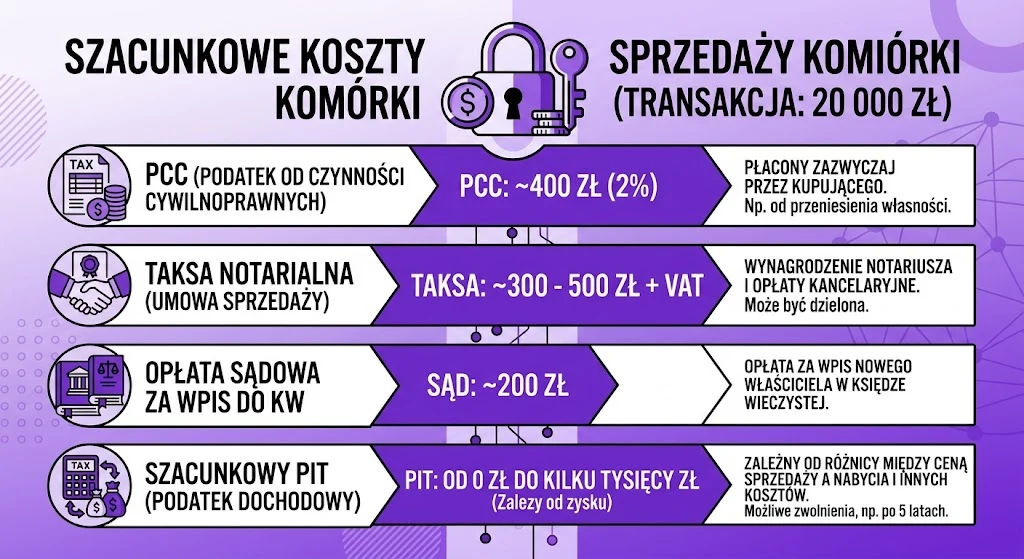
All amounts are indicative and depend on your individual situation, notarial rates and the tax rules in force.
How to price and list a storage unit for sale
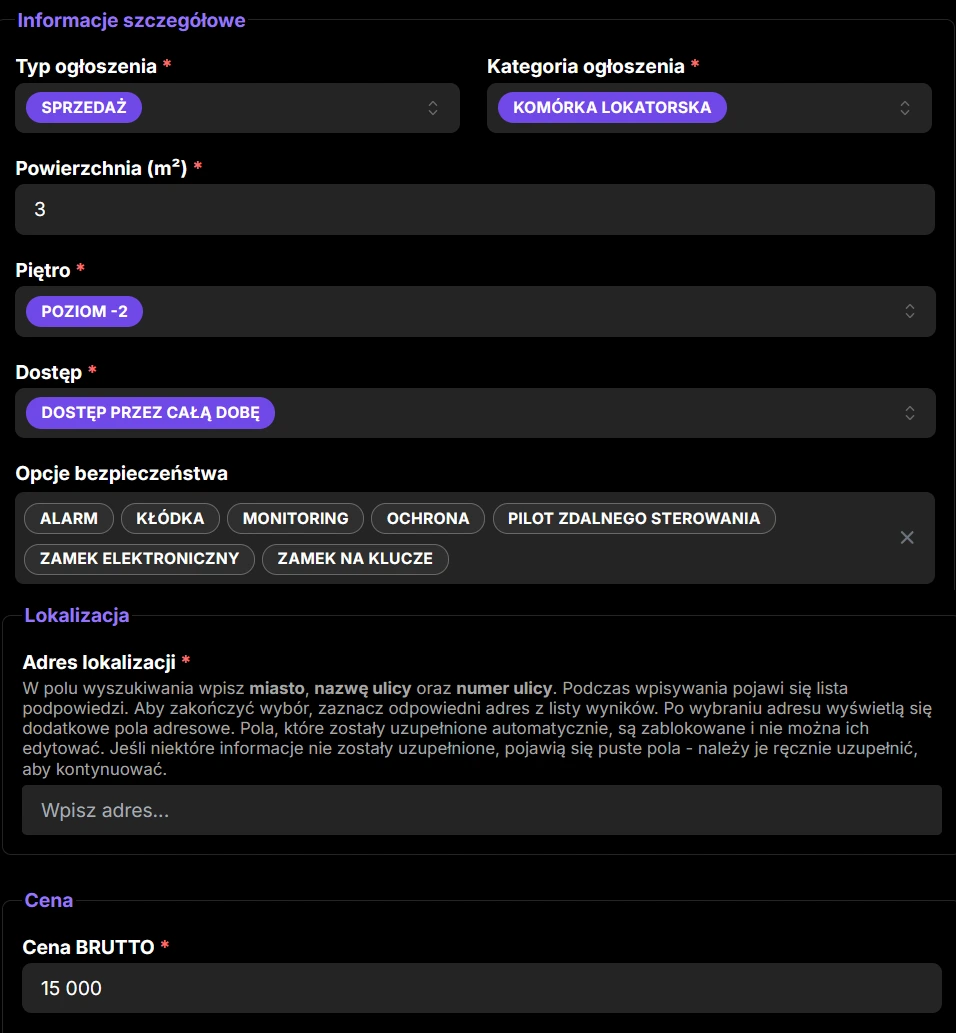
Before you publish a listing, check the real price range for your city and floor area on the page with storage units for sale - indicative prices usually run from 15,000 to 25,000 zloty for a typical 3-5 m², with local differences between Warsaw, Wroclaw and Gdansk.
In the listing itself make sure to give:
- the floor area of the unit,
- the floor or location within the building: basement, underground car park, residential corridor,
- the legal status, that is whether the unit already has its own land register or is still to be separated,
- real photos of the interior.
Listings without this information wait longer for a buyer. The rules for adding a listing, that is account verification, photos and the description, are on the how to add a listing page.
If, after going through the procedure above, you conclude that separating the unit is not worth it, the alternative is renting the storage unit out - with no change to its legal status, and regular income instead of a one-off amount.

Marsel Zychowski
MaszBox Team
We share practical know-how on renting and selling space - garages, warehouses, storage units, parking spots and more.