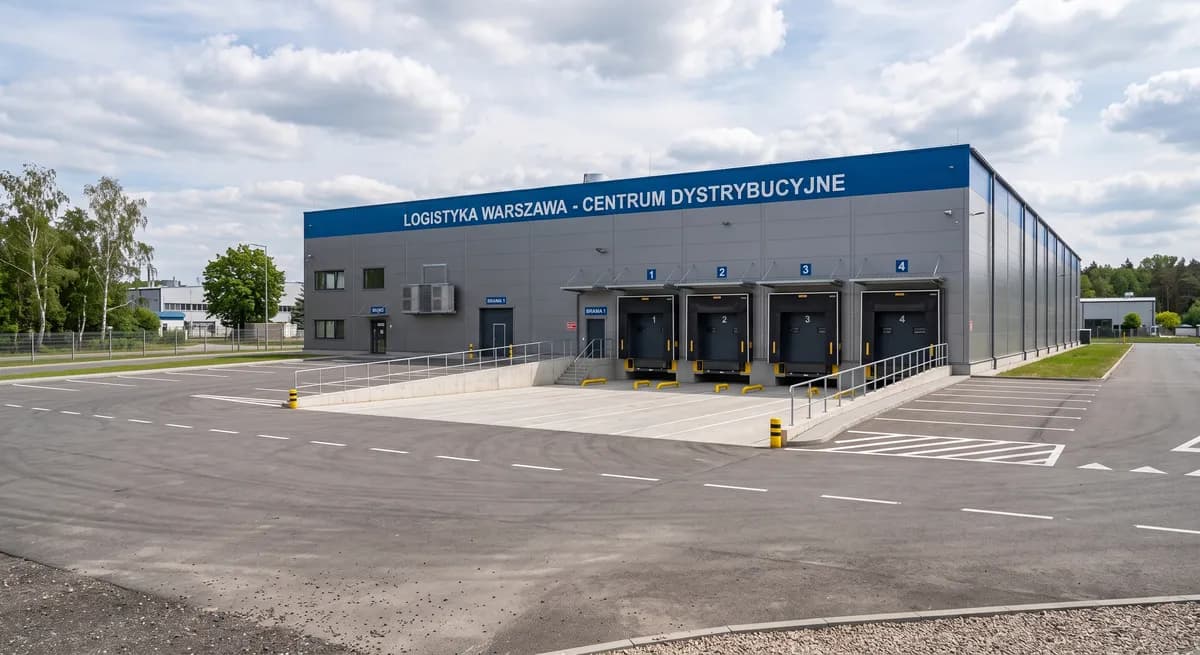
Before you start: prepare the warehouse specifications
| What to give | Why a company asks about it |
|---|---|
| Warehouse and office floor area (m²) | Lets them compare the offer with others and estimate the cost. |
| Clear height / storage height (m) | Decides how many rack levels will fit. |
| Doors: number, dimensions, type | A forklift and large pallets need a suitable entrance. |
| Loading ramp or docks | Without a ramp a semi-trailer cannot be unloaded efficiently. |
| Floor load capacity (t/m²) | High-bay racking and heavy goods need a strong floor. |
| Access and manoeuvring yard | Tells them whether an articulated lorry can get in. |
| Heating and temperature | Some goods must not freeze. |
| Power connection capacity | Important for electric forklifts, cold storage or production. |
| Office, staff facilities, parking | Matters when people are to work on site. |
| Security, CCTV, 24/7 access | Affects the safety of the goods and the working hours. |
Only give data you know for sure. If you do not know the floor load capacity, do not guess it.
Formalities on the owner's side
Intended use of the building
The building should be lawfully used as a warehouse. If you want to rent out a building with a different intended use as a warehouse, for example a farm building, a barn or a production hall, the change of use may require a notification to the county office. Check this before signing the agreement.
Building inspections and fire safety
- Periodic inspections (Article 62 of the Polish Construction Law): the technical condition of the building is checked at least once a year. For buildings with a built-up area of more than 2,000 m² and other structures with a roof area of more than 1,000 m², the inspection takes place twice a year, by 31 May and by 30 November. The owner or the manager is responsible for it.
- Fire safety instructions (§ 6 of the Regulation of the Minister of the Interior and Administration of 7 June 2010): a warehouse building must have them if its cubic volume exceeds 1,000 m³ or it contains an explosion hazard zone. They are updated at least once every 2 years and after a change of use.
- Fire extinguishers, fire protection equipment and escape route signage (§ 4(2) of the Regulation): the owner, the manager or the user of the building is responsible for keeping them in working order.
Since some of these duties lie with both the owner and the user, write down in the agreement who is responsible for what and who bears the costs.
Step 1. Sign in or create an account
Sign in to your account, or create a new one if you do not have one yet. Then click the “Add listing” button.
Step 2. Fill in the location
Enter the exact location:
- city,
- street,
- building number,
- district (if it was not filled in automatically).
Step 3. Enter the listing title
Enter a title with the key specifications, for example: Warehouse 800 m² with a loading ramp, 8 m height - Poznań, Franowo.
Step 4. Fill in the listing description
You can use this template and fill in the fields in brackets:
Warehouse for long-term rent at [street] in [city], [name] district.
- floor area: [X] m² of warehouse + [X] m² of office / staff facilities
- clear height: [X] m, floor load capacity: [X] t/m²
- doors: [number] × [width × height] m, [ramp / docks / ground-level access]
- access: [for articulated lorries / up to 3.5 t], manoeuvring yard: [yes / no]
- [heated / unheated], power: [capacity] kW
- security: [CCTV / fencing / guards], access: [24/7 / hours X-Y]
- price: PLN [X] net + VAT / PLN [X] gross, PLN [X]/m²
- available from: [date], minimum rental period: [X] months
Only describe what is true.
Step 5. Add photos
Add photos of the warehouse. The maximum size of one photo after compression is 5 MB. Allowed file formats are:
- jpeg,
- png,
- webp.
Show the building from the outside, the doors and the ramp, the manoeuvring yard, the interior photographed so that the height is visible, as well as the office and the staff facilities. Take photos in daylight. Do not show number plates, faces or the previous tenant's goods.
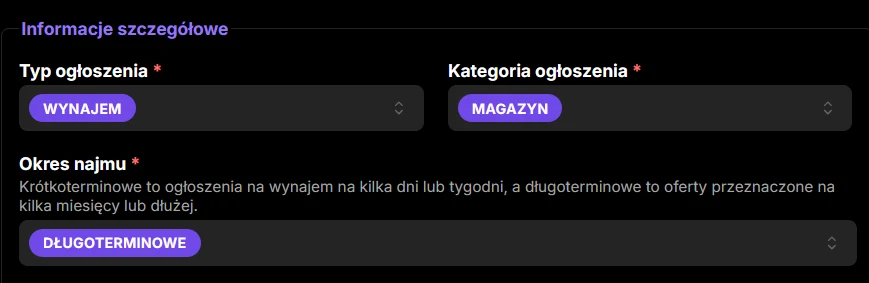
Step 6. Pick the listing type
Pick the listing type: Rent.
Step 7. Pick the listing category
Pick the category: Warehouse.
Step 8. Pick the rental period
Pick the rental period: Long-term. For a long-term rental you do not set availability dates.
Step 9. Pick the condition
Set the condition, for example New / renovated. Pick the option that matches reality, that is what the photos show.
Step 10. Enter the floor area
Give the floor area in square metres (m²). If you rent out an office together with the warehouse, give its floor area separately in the listing description.
Step 11. Pick the floor
Set the floor, for example Ground floor.
Step 12. Pick the access
Pick the type of access, for example 24/7 access. Pick the option the tenant can really count on.
Step 13. Tick the extra options
Tick the security and usage options that are really available.
Step 14. Enter the price
Enter the gross price for one month of rent, that is the amount the tenant will actually pay.
- You are an active VAT payer: renting out a warehouse is not exempt from VAT, so you add 23% VAT to the net rent. Enter the gross amount in the price field. In the listing description you can also give the net price, for example “PLN 10,000 net + 23% VAT”, because companies usually compare offers net.
- You rent out as a private person and are not a VAT payer: your price is the final price.
You can check the rates of similar warehouses in the warehouses for rent listings.
Step 15. Accept the consents and declarations
Read and accept the required consents and declarations.
Step 16. Add the listing
Once all the details are filled in, click the button to add the listing. Your listing will appear in the warehouses category. You will find the general rules for adding listings on the how to add a listing page. If you have several warehouses or halls, you can also present your offer in the directory of companies.
After adding the listing: the warehouse rental agreement
You sign the agreement directly with the tenant. Maszbox.pl is a listings service and is not a party to that agreement. Put the warehouse rental agreement in writing. It usually covers:
- an exact description of what is rented: floor area, rooms, yard and parking spaces,
- the net rent and VAT, the payment date and the rules for indexing the rent,
- utility charges and how they are billed, for example by sub-meters,
- security: a deposit or a bank guarantee,
- the rental period and the notice rules,
- the intended use of the warehouse and a ban on storing hazardous materials without your consent and without meeting the legal requirements,
- the split of duties: inspections, fire safety duties, repairs, clearing snow from the roof and the yard,
- insurance: you insure the building, and the tenant insures their goods and their third-party liability.
You can read more about insuring goods stored in a warehouse in our guide insuring belongings in a rented warehouse.
If the tenant is a private person and you sign the agreement online, as a business you are also subject to consumer rights rules.
Tax on renting out a warehouse
- A private person renting out a warehouse outside a business pays a flat-rate tax: 8.5% of revenue up to PLN 100,000 a year and 12.5% on the excess. They usually also use the VAT exemption until their turnover exceeds the statutory limit. For higher amounts, ask an accountant.
- A company settles the rental revenue as part of its business.

Marsel Zychowski
MaszBox Team
We share practical know-how on renting and selling space - garages, warehouses, storage units, parking spots and more.