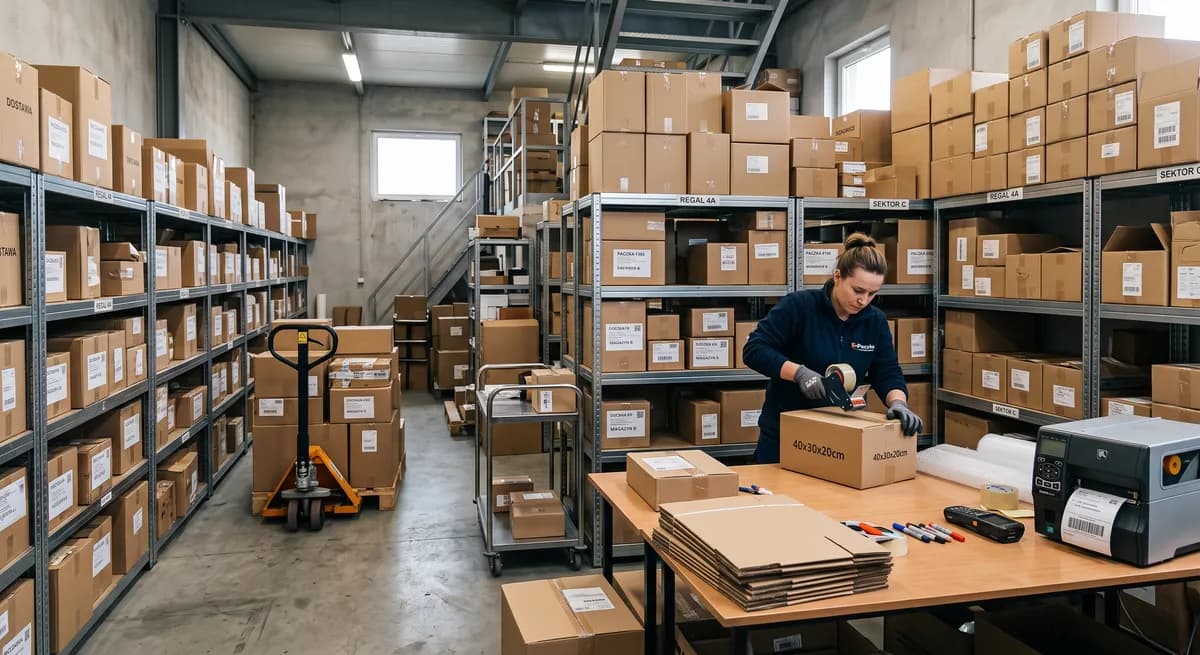
A badly organised small space quickly starts to cost money. Cardboard boxes standing on the floor of an unheated box can soak up damp over the winter and ruin the stock. Without labelled shelves every order means searching, and with a dozen or so shipments a day it is easy to mix up a size or colour and get a return at your own expense.
Below we show how to set up a small rented warehouse: from what you are allowed to change, through shelving and labelling, to protection from damp and organising shipments.
Before you put in shelving: check what the contract allows
In a rented box you are not in your own place. Before you buy shelving, check the contract or ask the landlord:
- whether you can drill into the walls and screw shelving to them,
- whether you can anchor anything to the floor,
- whether you have to restore the original condition when the rental ends, and if so, to what extent.
If the answer is "no", you are left with freestanding shelving. In practice that is the best choice for a rented space anyway: you take it with you when you move and you do not risk deductions from the deposit. What else to look out for in the contract before renting is described with the offers of warehouses for rent.
Shelving in a small box
In a few square metres you gain the most space vertically, not on the floor.
- Use the height. Measure the box at its lowest point and choose shelving that leaves a few centimetres to spare under the ceiling.
- Heavy at the bottom, light at the top. A tall freestanding shelving unit that is not screwed to the wall is stable only when the heaviest stock sits on the lowest shelves.
- Leave a walkway. It is most convenient to place the shelving along the longer walls and leave the middle free, so you can stand there with a box in your hands.
- Match the shelf depth to the stock. In a small box, shelves that are too deep take away the walkway, and stock at the back is hard to reach anyway.
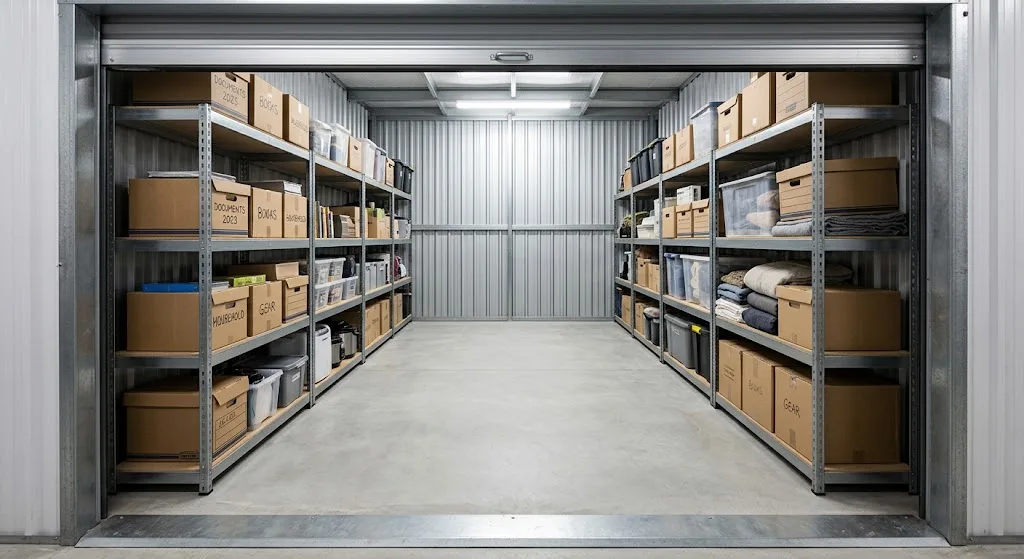
Dividing it into zones, even in a few m²
Even in a small box it pays to set aside three areas, so that stock does not get mixed up:
- a receiving zone by the door, where you put a new delivery before unpacking it,
- a storage zone on the shelving further in,
- a packing zone, ideally also by the door. A folding worktop or a small table that you tuck against the wall after work is enough.
Keep the best-selling stock on the shelves closest to the packing zone. With a dozen or so orders a day this saves a lot of walking.
Labelling stock so you do not mix up orders
Shipping mistakes usually happen because similar products lie next to each other without a description. The simplest system:
- number the shelving units and shelves, for example A1, A2, B1: the letter is the shelving unit, the number is the shelf,
- mark each spot with a label showing the name or code of the product kept there,
- keep a location list, even in a spreadsheet: the product and its place on the shelving.
There are two approaches. Fixed locations (each product always on the same shelf) are simplest with a small range of products. Free locations (stock goes wherever there is a gap) make better use of the space, but without a reliable location list things quickly get messy. In a small box, fixed locations usually win.
Protecting stock from damp in an unheated box
Many small warehouses are not heated, and the concrete floor and walls give off moisture, especially in autumn and winter. How to protect your stock:
- Nothing directly on the floor. The lowest shelf of the shelving or wooden platforms keep boxes away from the cold concrete.
- A few centimetres from the wall. Shelving pushed right up against a cold wall hinders air circulation and encourages condensation.
- Closed containers for sensitive stock. Textiles, paper and electronics are better kept in plastic containers with lids than in open cardboard boxes.
- Moisture absorbers in the box and regular checks for water stains on the walls.
If you sell stock that is very sensitive to temperature and damp, check whether the space is heated when you choose it. We describe the differences between a warehouse inside a building and a container in this respect in the article warehouse or container.
Pack in the warehouse or at home?
The answer depends on when you have access to the box.
Round-the-clock access: pack on site. The stock does not leave the warehouse, and you do not bring boxes or wrapping film into the flat.
Access only at set hours: working in batches works better. Once every day or two you take the stock for that period's orders and pack at home. This requires a good location list from the previous section, because you have to collect everything in one visit.
Before renting, also ask whether a courier can collect parcels directly from the facility. If not, you have to allow time for taking them to a drop-off point.
You secure the door and lock just as in any storage space. Proven methods are described in our guide on how to secure a storage unit against theft. With a very small range of products, for example a few dozen items, a storage unit close to home may be enough instead of a warehouse. You will find all warehouse offers in the warehouses category.


Marsel Zychowski
MaszBox Team
We share practical know-how on renting and selling space - garages, warehouses, storage units, parking spots and more.